Stock Market Fund-Flow Factors from Tick-by-Tick Trade Data: A Long Road Still Ahead

Unlike volume factors, which examine aggregate trading volume over a period, the fund-flow factors in this article are computed from tick-by-tick trade data and study microstructure features created by trading itself, such as whether the counterparty is trading in large or small orders and how posted order sizes are distributed. Tick-by-tick trade data is large enough to create serious engineering challenges for factor computation. This article first introduces a single-machine computation framework and then briefly summarizes the existing research results on fund-flow factors.
Read more
Quant 4.0 (III): Explainable AI, Knowledge-Driven AI, and Quantitative Research

Quant 4.0 (III): Explainable AI, Knowledge-Driven AI, and Quantitative Research

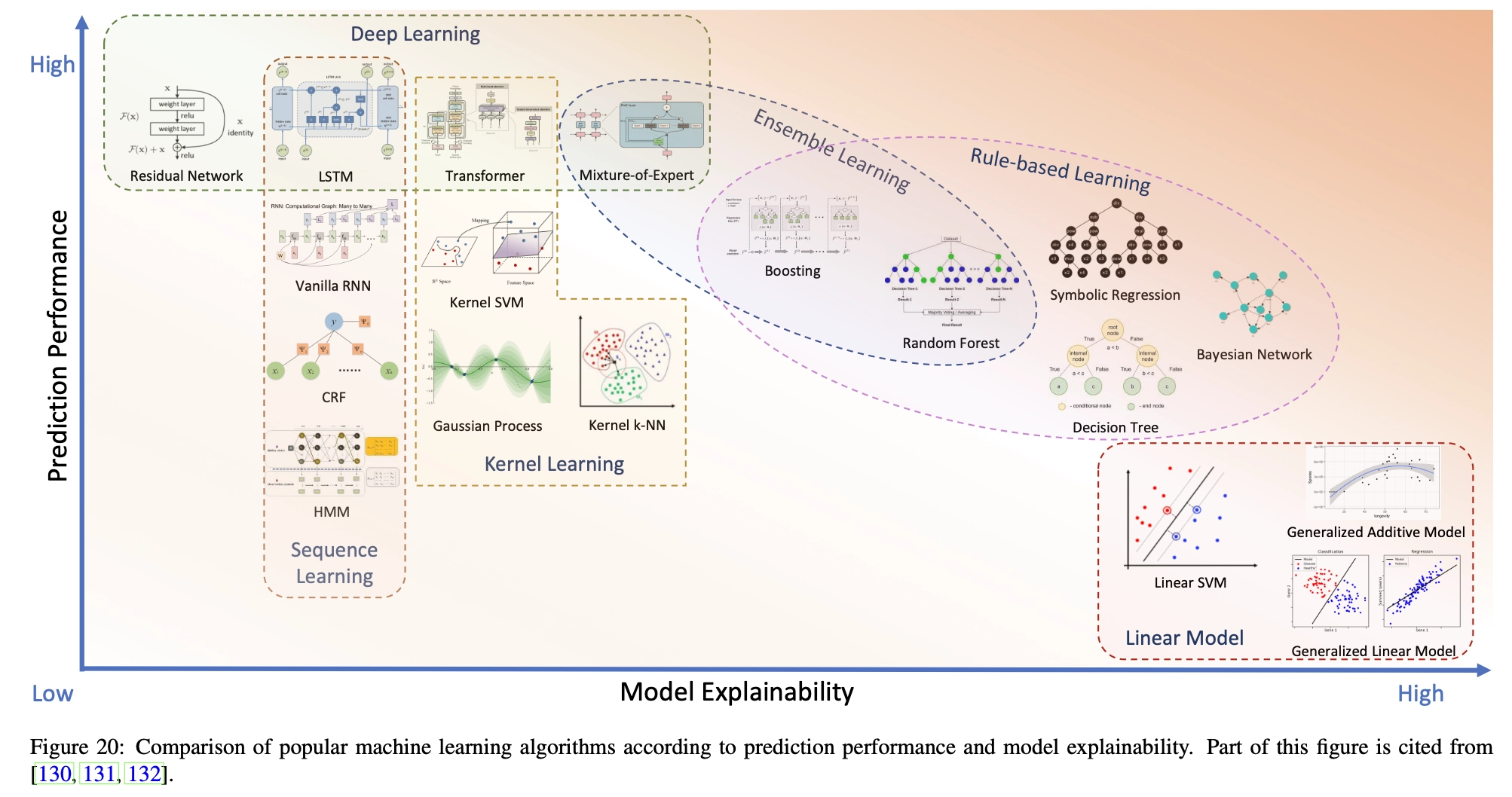
XAI (Explainable Artificial Intelligence) has been an important research direction for decades and is crucial to the credibility and robustness of artificial intelligence models. In the quantitative field, improving the explainability of AI can make decision-making processes more transparent and easier to analyze, provide researchers and investors with useful insights, and uncover potential risk exposures. In this article, we will discuss how to leverage XAI in Quant 4.0: the first part introduces common XAI techniques, and the second part connects these techniques to practical quantification scenarios. Knowledge-driven artificial intelligence is an important complementary technology to data-driven artificial intelligence, especially in low-frequency investment scenarios such as value investing and global macro investing. At the end of this article, we introduce how to apply knowledge-driven artificial intelligence to quantitative research.

Read more
Quant 4.0 (II): Automated AI and Quantitative Research

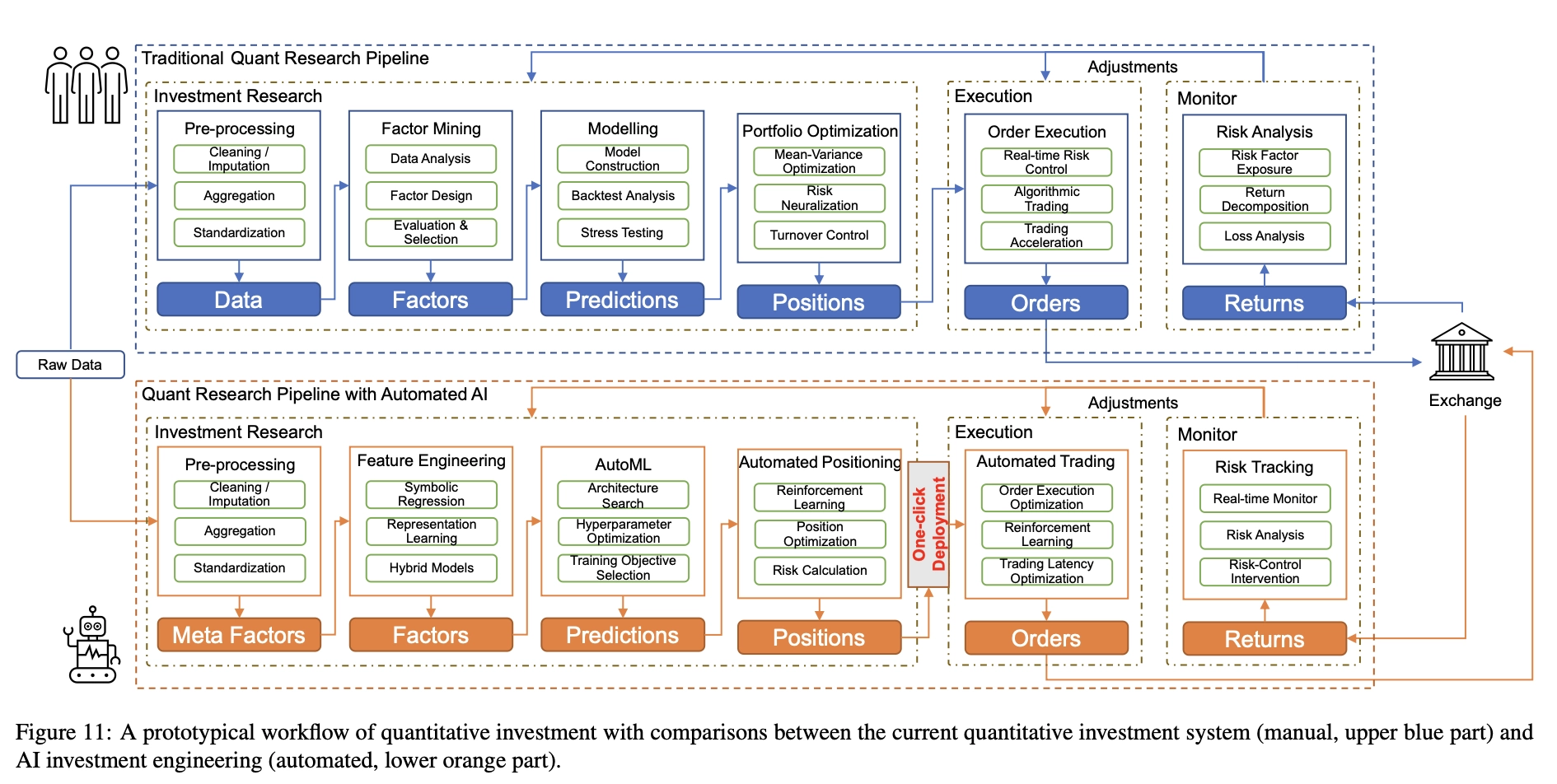
Quant 4.0 (I): An Introduction to Quantitative Investment, from 1.0 to 4.0

In recent years, the quantitative investment industry has been booming in China and has become an unavoidable topic when discussing the secondary market. It is either mythical or criticized by everyone. So, what exactly is quantitative investment (Quantitative Investment)? What quantitative strategies are there? Are quantitative strategies guaranteed to make money? What are the basic principles for building a quantitative strategy? This article introduces the basic concepts of quantitative investment, its past and present, and looks forward to its future development model.

Read more

Why Live Trading Underperforms Backtests: Detecting Backtest Overfitting from Multiple Testing

Backtesting is the core link in quantitative strategy research and development, and it is also the key difference between quantitative investment and traditional active investment. Backtesting refers to conducting simulated transactions on an investment strategy that can be accurately characterized in a historical simulation environment, and using the historical performance of the strategy to infer its future performance, thereby making choices among multiple groups of strategies to form the final investment decision. Based on a brief introduction to backtest overfitting, this article further discusses the quantitative evaluation indicators of the historical performance of trading strategies, focusing on the false positives caused by multiple tests during the backtesting process. Quantitative trading uses computer programs to realize automated trading. Its key difference from traditional active investing is its reliance on “backtesting” to verify the effectiveness of the proposed strategy and estimate its expected performance. In the context of the growth of computer computing power and algorithm development, researchers have implemented an increase in the number of backtests. Multiple tests have led to frequent false positives. The seemingly best strategies during the backtest period lack the ability to generalize to out-of-sample data. This phenomenon is called backtest overfitting. How to estimate the probability of backtest overfitting and adjust expected performance indicators such as the Sharpe ratio to correctly reflect the true performance of the strategy under the influence of multiple tests has become an emerging research direction.

Read more
Volume Factors: Turnover and Illiquidity

Volume Factors: Turnover and Illiquidity

Trading volume is an indispensable part of the volume price factor, but in most cases it appears as a supporting role in the coordination of volume and price, as discussed in Volume Price Relationship Factor and Momentum Reversal Factor. This article focuses on the trading volume itself and discusses two important stock selection factors: turnover factor and illiquidity premium. The trading volume factor has significant predictive effect on stock cross-sectional returns in global markets, especially in immature markets such as A-shares.

Read more

Momentum and Reversal Together: Two Unified Frameworks for Trend Factors

The short-term reversal effect is the same as the small market capitalization factor. It has steadily contributed significant excess returns over a long period of time in the past. A single factor alone can achieve an annualized rate of return of 40%+. Unfortunately, the good times did not last long. Since 2019, the performance of the reversal factor has been extremely unstable, with large retracements, poor long-term monotonicity, and even momentum effects in some time periods and in the index domain. So has the short-term reversal effect degenerated into a style factor? How to improve the reversal factor, and in factor investment practice, can momentum and reversal be treated uniformly under the same framework? This article introduces the optimal construction of inversion factors and summarizes two unified frameworks.

Read more
The Interweaving of Price and Volume in Factor Investing: A Complete Guide to Price-Volume Relationships

The Interweaving of Price and Volume in Factor Investing: A Complete Guide to Price-Volume Relationships

There are already a vast number of technical indicators derived from price sequences, and the complexity of comprehensively considering the relationship between volume and price has increased by more than one order of magnitude. From word-of-mouth mantras about the relationship between volume and price, to high-dimensional deep time-series neural networks, from monthly long-term volume and price trends, to instantaneous impacts on the order book, people are endlessly exploring the relationship between volume and price. This article systematically analyzes some representative volume-price relationship indicators from the perspective of factor investment, hoping to provide reference and inspiration for mining volume-price factors in this area.

Read more
Low-Risk Anomalies: Properties, Causes, and Low-Volatility Factor Construction

Low-Risk Anomalies: Properties, Causes, and Low-Volatility Factor Construction

In the long run, the expected return of low-volatility stocks is higher than that of high-volatility stocks. This is the low-volatility (low-risk) anomaly that has existed in global markets for a long time. This article introduces the main nature and causes of low-risk anomalies, and lists common factor construction methods, hoping to provide an outline and guidance for factor investment in the volatility category among volume and price factors.

Read more